



The following article is excerpted from our Q1 2026 market commentary, Could the Tanks Run Dry? In it, we examine why global energy markets may be far tighter than consensus believes and what that could mean for oil prices going forward.
Commodity markets, and energy markets especially, have always possessed a peculiar instability. Periods of acute shortage and extraordinary profitability have a habit of convincing investors that prosperity will persist indefinitely, while periods of collapse usually persuade them of precisely the opposite. The resulting swings can last far longer than logic would seem to permit.
Most of the large moves are driven not by geology, but by psychology and the capital spending cycle. When a commodity market slips into deficit, prices rise sharply and producers begin earning exceptional returns. Capital eventually follows, although bringing on meaningful new supply is rarely a quick process. New mines, pipelines, export terminals and offshore projects often require years before the first incremental barrel or ton reaches the market. By the time that supply finally arrives, the shortage that justified the investment has usually become widely recognized, and too much capital has been committed. The deficit turns into surplus, prices fall heavily, and investor enthusiasm evaporates almost as quickly as it appeared. Capital leaves the industry, depletion gradually tightens the market once again, and the cycle begins anew. In commodity markets, these cycles often take a decade or more to fully resolve. There are very few quick cures.
Short-term volatility, however, is usually caused by something altogether different. In those instances, the problem is not psychology or overinvestment, but rather a physical bottleneck somewhere within the system itself. These disruptions can be sudden, violent, and wholly disproportionate to the underlying imbalance that caused them.
Natural gas markets offer some of the clearest examples. During especially cold winters, inventories can draw down at an alarming rate. In Boston, where pipeline infrastructure is notoriously constrained, the city occasionally finds itself perilously short of dispatchable supply during severe cold snaps. Under those conditions, prices have been known to rise twenty-fold in only a matter of days, as utilities and industrial users compete desperately for the last available molecules of gas.
Over long periods of time, commodity prices tend to gravitate toward their fully burdened cost of production. In the short run, however, prices are often determined not by average economics, but by the marginal barrel or molecule needed to balance the market at that particular moment.
During periods of acute surplus, the clearing price can collapse with astonishing speed. The opening weeks of the COVID lockdowns provided perhaps the clearest example in modern history. As demand evaporated and storage rapidly filled, oil prices briefly turned negative, forcing producers to shut in wells across several major basins. Shortages produce the opposite effect. When supply becomes insufficient, prices must rise high enough to ration demand, often very abruptly. The episodes in Boston during severe winter shortages are a good example: the physical shortage itself may be relatively small, but because the market must suddenly determine which users go without supply, prices can behave in a manner that appears almost irrational.
Inventories exist largely to absorb these sorts of shocks. They serve as a buffer between the steady pace at which energy is consumed and the far less stable pace at which it is produced, transported and refined. So long as inventories remain ample, the system can usually tolerate temporary disruptions without much visible strain.
The character of the market changes once that buffer begins to disappear — or proves inaccessible just when it is needed most. At that point, price becomes the rationing mechanism. What follows is rarely orderly. As inventories approach critically low levels, price movements tend to become increasingly erratic and nonlinear. Small disruptions that might ordinarily pass unnoticed suddenly produce outsized effects. The transition itself is often abrupt. A market that appears merely tight one week can look catastrophically undersupplied the next.
Energy history is full of such moments. The oil shocks of the 1970s produced the now-famous gasoline lines across the United States. In 2008, crude prices rose almost vertically as spare capacity and inventories dwindled simultaneously. In 2020, the process reversed spectacularly when storage tanks filled during the COVID lockdowns and WTI prices briefly collapsed below zero. In each case, inventories — either too scarce or too abundant — sat at the center of the dislocation.
Every so often, a longer-term commodity cycle collides with a shorter-term physical dislocation. When that happens, the result is often not merely a temporary price spike, but a much larger structural repricing.
The 1970s remain the classic example. After years of inadequate upstream investment, U.S. oil production unexpectedly peaked in 1971 and began to decline. At the time, few appreciated the significance of the reversal. Then came the Arab oil embargo in 1973, which created what was, at that point, an unprecedented physical disruption to global supply. Crude prices surged nearly 80% within a month. After a brief pause, they resumed their ascent, ultimately rising several-fold over the next year and a half. Oil had entered the decade trading near $3 per barrel. Before long, it was spending sustained periods above $30.
A remarkably similar pattern unfolded in the years leading up to 2008. Following another prolonged period of weak upstream investment, the two largest sources of non-OPEC supply growth — the North Sea and Mexico’s Cantarell field — both began to roll over unexpectedly. At the same time, emerging market demand growth accelerated sharply, leaving global inventories increasingly thin. With very little buffer remaining in the system, crude prices rose roughly three-fold in only eighteen months before eventually stabilizing near $95 per barrel between 2010 and 2014 — nearly eight times the lows reached in 1999.
In both episodes, the underlying market had already become structurally tight well before prices fully reflected it. The physical disruption merely exposed conditions that had been quietly building for years.
We believe the market may once again be entering one of these periods.
Following the shale boom of the 2010s, the upstream oil industry endured nearly a decade of chronically weak investment. For most of the last fifteen years, shale accounted for virtually all non-OPEC supply growth worldwide. That engine now appears to be faltering. Growth across nearly every major shale basin outside the Permian has already stalled or turned negative, and even the Permian itself is no longer growing at anything close to its former rate.
At the same time, the closure of the Strait of Hormuz has introduced a physical disruption without precedent in the modern history of global energy markets. Roughly one-fifth of the world’s seaborne oil trade ordinarily passes through the Strait each day. The market has never before attempted to function for an extended period with such a large volume impaired simultaneously.
The combination is unusual. The industry appears to have entered another structurally tight phase following years of inadequate capital spending, just as the market confronts an acute physical bottleneck of historic proportions. The last time crude traded at extreme lows was during the depths of the COVID lockdowns, when WTI briefly fell below $20 per barrel in April 2020. If oil were once again to experience the sort of eight- to tenfold repricing seen during prior structural shifts, several years of $120 to $150 oil no longer seem nearly as implausible as investors presently assume. That eight-to-ten-fold frame is the thesis of this letter, and the analysis that follows is in service of it.
As we write, Operation Epic Fury is now in its seventy-sixth day, and the Strait of Hormuz has been closed for most of that time. There is little evidence that a resolution is any nearer today than it was several weeks ago. By any ordinary historical measure, this should have produced something close to panic in the oil market. Instead, the response has been remarkably subdued.
At least 15 million barrels per day of supply appears to be directly curtailed. On volume alone, the disruption exceeds every previous oil crisis. Yet dated Brent — still the best measure of physical delivered crude — managed at its peak to exceed its 2008 high by only $4 per barrel. Spot futures performed even less impressively, failing to reach their 2022 highs and remaining more than $30 below the peak recorded in 2008.
The contrast is striking. Neither in 2008 nor in 2022 was the physical market nearly as impaired as it is today. There were even several days in 2011, a year with no comparable supply disruption at all, when oil traded at higher prices than it has during the present crisis. The market, in other words, has been presented with an energy dislocation larger than any previously recorded and has responded as though it were a difficult but ultimately temporary inconvenience.
At the beginning of the year, WTI crude traded near $58 per barrel, placing it in the lowest quartile of nominal prices observed over the past fifteen years. Adjusted for inflation, oil ranked in roughly the lowest decile of historical readings. Measured in gold terms — a frame-work we discussed at length in our previous letter — crude began the year cheaper than at any point in modern history apart from the extraordinary lows briefly reached during the COVID collapse in 2020.
Investor sentiment reflected this extreme pessimism. Much of the bearishness stemmed from forecasts published by the International Energy Agency, which projected a surplus of roughly 2 million barrels per day for 2025, widening to 3.5 million barrels per day in 2026. Had those figures proven correct, the market would have been facing the largest glut in its history.
We never found those estimates particularly convincing. Our own work suggested the previous year’s surplus was materially smaller than widely believed, and that underlying demand was both stronger and growing considerably faster than consensus estimates implied. At the same time, shale production growth — which had supplied virtually all incremental non-OPEC production for more than a decade — was slowing rapidly. Taken together, the market appeared to us far closer to balance than most investors appreciated. We believed 2026 would likely begin in approximate equilibrium before slipping into outright deficit later in the year.
We positioned the portfolio accordingly. In January, we sold a substantial portion of our gold-equity holdings and redirected the proceeds into oil and natural gas investments.
On February 28th, the United States and Israel launched Operation Epic Fury. Crude prices responded immediately, rising roughly 75% within a month. At first glance, the move appeared dramatic. A closer inspection of the futures market, however, revealed something rather different.
While spot prices surged sharply, longer-dated crude contracts moved far less. Oil for delivery twelve months forward rose only about 25%, and even after the rally remained well below prior peaks in nominal terms — roughly $70 per barrel below the highs reached in 2008, $35 below those seen in 2011, and $27 below the 2022 peak.
The distinction matters. Spot markets tend to reflect immediate physical stress, whereas the outer years of the futures curve reveal what investors believe about the durability of that stress. In effect, the market was signaling that while the disruption might prove painful in the near term, conditions would normalize before long. The prevailing assumption seems to be that once the Strait reopens, the market will quickly revert to surplus and inventories will rebuild without much lasting difficulty. Implicit in this view is the belief that even if roughly one billion barrels of supply were disrupted during the closure, a return to a surplus of 3 million barrels per day would allow the system to restore inventories to their January levels within a year or so.
This confidence extends well beyond the oil market itself. After initially falling roughly 9% when hostilities began, the S&P 500 subsequently rallied nearly 20% and now stands materially above its prewar level. Speculative enthusiasm has returned most visibly to technology and artificial-intelligence shares. Since bottoming on March 30th, the tech-heavy Nasdaq Composite has advanced nearly 30%, roughly twice the gain recorded by the broader market. Financial markets are behaving as though the world is simultaneously confronting the largest physical disruption in energy history and no meaningful disruption at all.
Energy equities, meanwhile, have behaved far more like the deferred crude contracts than the spot market itself. The Energy Select Sector SPDR Fund, which is dominated by large integrated oil companies, has risen only modestly since hostilities began. The SPDR S&P Oil & Gas Exploration & Production ETF — typically far more sensitive to changes in crude prices because of its heavier exposure to exploration and production companies — has performed somewhat better, though hardly in a manner one might expect during a supply disruption of this magnitude.
Investor flows tell a similar story. Since the end of February, only about $7 billion of net capital has entered the two ETFs combined. That figure is notable chiefly because of how small it is. Between 2022 and 2025, we estimate investors withdrew roughly $20 billion from the same vehicles. The broader pattern suggests that investors continue to view the present episode not as the beginning of a larger structural shift, but rather as a temporary interruption within a market they still fundamentally distrust.
Because the broader equity market has advanced much more rapidly than energy shares, the sector’s weighting within the S&P 500 has actually drifted slightly lower since the conflict began. Energy today represents only about 3.2% of the index — a small fraction of the roughly 16% weighting reached during the 2008 commodity peak, and not dramatically above the all-time lows recorded during the depths of the COVID collapse.
Several news reports last week pointed to another supposedly reassuring development: the premium commanded by physical crude for immediate delivery has fallen sharply from the extreme levels reached earlier in the conflict. By some measures, those premiums have declined nearly 90% from their February highs.
Recent market action suggests to us that after a brief short-covering rally in energy, investors have largely returned to the so-called “carry trade.” In our 4Q2025 letter, we described the mechanics of this feedback loop, in which investors become heavily levered short volatility. In essence, they are betting that whatever has been working will continue to work. As part of this trade, we suspect many investors are effectively short energy exposure in order to increase their long exposure to momentum stocks, technology shares, and other high-valued long-duration assets. Apart from the brief rally immediately following the outbreak of the war, this pattern appears to have remained firmly in place.
Investors continue to dramatically underprice the upside risks facing global energy markets, both over the short term and the longer term. Yet the underlying data increasingly suggests the market may be approaching an important inflection point.
Short Term
In the immediate term, it is difficult to overstate the magnitude of the supply shock caused by the closure of the Strait of Hormuz, though the full physical effects have yet to be truly felt. Before the conflict, roughly 20 million barrels per day moved through the Strait. Since then, several bypass pipelines have increased throughput materially, but even after accounting for those adjustments, approximately 15 million barrels per day remains impacted.
In the opening days of the crisis, producers reacted in a predictable fashion. Every available tanker trapped inside the Gulf was hastily filled, along with virtually every accessible onshore storage tank. In aggregate, this emergency stockpiling absorbed roughly 120 million barrels. Once the tanks and vessels were full — a matter of only several days — producers had little choice but to begin shutting in field production.
Accounting for this one-time inventory build, our analysis suggests that with the Strait now closed for more than seventy-five days, over one billion barrels of production that otherwise would have reached the market has been curtailed. At 15 million barrels per day, the disruption presently affects roughly 15% of global oil supply — approximately three times larger in absolute volume, and twice as large relative to the size of the world oil market, as the Arab oil embargo of 1973.
The physical market has no obvious replacement for this lost production, and our analysis suggests the global commercial system risks severe breakdown even if the Strait were reopened immediately. Why then, one might reasonably ask, have we not yet seen major global dislocations? And why do investors remain so calm?
We believe the answer lies largely in delays, both within the physical supply chain itself, and in the data investors use to attempt to measure it. Oil moves slowly through the global system. So does information. In both cases, the true condition of the market often reveals itself only after the underlying imbalance has become considerably more serious than first believed.
On the physical side, we estimate that the time required for oil to move from the wellhead to final consumption can approach ninety days. The process is considerably slower, and far more complicated, than is commonly appreciated.
Crude oil may require roughly five days simply to travel from the producing field to the export terminal or loading facility. From there, after accounting for loading, ocean transit and discharge, the cargo can spend another eighteen to twenty-two days in motion. Once unloaded, the crude typically does not move directly into the refinery process. Instead, it sits in storage tanks while refiners assemble the appropriate blend of feedstocks, a process that can itself require anywhere from five to fifteen days. The refinery stage adds further delay. Hydrotreating, reforming, cracking and blending can collectively consume another week before refined products are ready for shipment. Even then, gasoline, diesel, and jet fuel usually remain in storage at the refinery gate for an additional five to fifteen days before entering the distribution network. From there, the products are batched and moved onward by pipeline, rail, or coastal tanker to regional distribution centers, a process that generally takes between one and five days. Finally, fuel is delivered to airport terminals, retail stations, and other end-users, each of which maintains its own inventory — often enough to cover anywhere from two to ten days of consumption. The result is a supply chain that stretches across continents and oceans, and whose delays are measured not in hours, but in weeks.
If we assume field production began shutting in roughly one week after the conflict started, then end users should only now be beginning to experience the first meaningful physical effects on refined product supply. Owing to the long delays embedded throughout the system, the consequences of a supply disruption of this magnitude do not appear all at once. They propagate gradually through the chain.
Refiners, naturally, would have encountered the problem first, and there are already signs this is occurring. A number of refining complexes around the world have reportedly reduced or idled runs because they cannot secure the appropriate crude feedstock. The strain appears most acute in Asia, where many refineries are specifically configured to process Gulf crude.
Refined-product markets are now beginning to reflect these pressures as well. Prices for diesel and jet fuel, in particular, have recently risen sharply in several regions, suggesting the disruption is beginning to move downstream into the broader economy.
Complicating matters further, China has sharply curtailed refined-product exports in an effort to protect domestic supply. The decision has made gasoline, diesel and jet fuel materially harder to source throughout the rest of Asia, where many countries had grown heavily reliant on Chinese exports to balance their own markets. Because Chinese refiners no longer need to produce export volumes, many have been instructed to reduce operating rates, thereby lowering immediate demand for crude oil itself. The short-term effect on crude pricing appears almost reassuring at first glance — but the problem has merely been pushed further down the chain. With refinery runs reduced sharply, global refined-product inventories are now drawing rapidly (likely faster than the available data presently captures), even as crude demand temporarily softens. This is not a permanent solution so much as a temporary postponement. Eventually, refined-product inventories will need to be rebuilt, and when that occurs, demand for crude oil could rise much more sharply than the market presently expects.
A second cushion has come from OECD strategic petroleum reserves, which have agreed to release roughly 400 million barrels over a one-hundred-day period — equivalent to approximately 4 million barrels per day, or somewhat less than one-third of the disrupted Gulf production. The measure has helped absorb some of the immediate shock, though it falls well short of fully replacing the missing supply.
Many investors appear to assume that additional SPR releases could easily follow if conditions deteriorate further. We are less certain. Unlike commercial inventories, strategic reserves are often stored in underground salt caverns and cannot be drawn indefinitely without operational constraints becoming an issue. Moreover, the present release comes on top of two already substantial drawdowns since 2022. It is therefore not obvious that OECD governments remain in a position — operationally or politically — to continue supplying the market at comparable rates for an extended period.
There is also a second consideration that receives far less attention, and which we believe deserves considerably more weight than the market presently assigns it. Once the Strait eventually reopens, countries with depleted strategic reserves will almost certainly feel compelled to replenish them — and likely to higher levels than before, given the demonstration effect of the present crisis. In effect, today’s emergency release becomes tomorrow’s incremental source of demand. We suspect that SPR restocking could provide at least a 1 million barrel per day tailwind to global oil demand over the next several years, and quite possibly more if multiple governments move to rebuild reserves simultaneously. This is precisely the sort of second-order effect that markets typically ignore until it is already underway.
Taken together, these developments have made the data increasingly difficult to interpret. Real-time estimates of global oil demand are derived largely from models whose inputs depend heavily upon observed refinery runs. Under ordinary conditions, refinery throughput tends to correlate quite closely with end-use consumption, making the relationship reasonably reliable. The present situation, however, is not ordinary. As discussed earlier, refinery runs are now being influenced heavily by China’s decision to prioritize its domestic market and curtail exports. Lower refinery throughput, therefore, may say less about weakening global consumption than about the growing difficulty of securing crude feedstock and refined-product supply within the broader system.
Making matters more difficult still, reliable global oil data operates with a considerable delay. Outside the United States, much of the world’s inventory, demand and trade data is reported only monthly, often with revisions arriving well afterward. In practice, this means the global market is frequently attempting to assess present conditions using information that is already one or two months old. The United States is something of an exception, owing to the unusually high quality and frequency of its reporting. Weekly inventory and refinery data are available with a level of detail unmatched elsewhere. Yet the U.S. is also relatively insulated from the worst of the present disruption because of its large domestic production base and comparatively limited dependence on Gulf crude imports. Investors may not be able to properly assess the true physical impact of the conflict for another month or two, by which point the market itself may already have changed considerably.
The International Energy Agency is presently reporting that global oil demand declined by roughly 4 million barrels per day in March and another 2 million barrels per day in April. We remain skeptical of those estimates. Mr. Rothman of Cornerstone Analytics has correctly pointed out that real-time global flight activity has historically correlated surprisingly well with overall oil demand, despite jet fuel accounting for less than 10% of total petroleum consumption. At present, the flight data suggests little evidence of any meaningful slowdown in global demand.
Instead, we suspect many analysts are inferring weaker consumption from reduced refinery throughput — a reasonable conclusion under ordinary circumstances, but a misleading one in the current environment, where lower refinery runs likely reflect physical crude shortages and Chinese export policy far more than any genuine deterioration in end-use demand.
History supports this view. Between 2010 and 2014, crude oil averaged roughly $95 per barrel, yet global demand continued growing by approximately 1 million barrels per day annually throughout the period. Adjusted for inflation, that average price would equate to roughly $142 per barrel today. In 1980, crude briefly reached the equivalent of approximately $150 per barrel in today’s dollars before meaningful demand destruction emerged, though oil expenditures then represented a much larger share of global incomes than they do today. The same pattern held in 2008, when demand destruction finally appeared only after oil approached the equivalent of roughly $200 per barrel in current dollars. Demand destruction will likely come eventually. Historically, however, it has tended to arrive not before higher prices, but because of them.
We turn now to the inventory picture, which is where the situation looks most precarious. At first glance, commercial stockpiles appear comfortably large. The International Energy Agency estimates that non-SPR inventories stood at roughly 6.5 billion barrels of crude oil and refined products at the end of February. Upon closer examination, however, the situation looks considerably less reassuring.
Much of this oil is not truly “inventory” in the ordinary sense of the word — that is, supply that can simply be withdrawn and consumed during a shortage. A substantial portion functions more like working capital within the global petroleum system itself. It exists not as surplus, but as the minimum volume required to keep a 106 million barrel-per-day market operating continuously.
While roughly 2 billion barrels of oil are reportedly floating aboard the global tanker fleet at any given time, we estimate that nearly 1.7 billion barrels must remain continuously at sea simply to sustain an 80 million barrel-per-day seaborne export market, given average laden voyage times approaching twenty days. Most of this oil is not excess inventory at all, but cargo in transit, permanently embedded within the functioning of the system itself.
The same principle applies elsewhere throughout the supply chain. We estimate that another 2.2 billion barrels are required within blending facilities, refinery systems and downstream distribution networks before normal operations begin to break down. Pipelines present a similar constraint. Roughly 1 billion barrels are needed globally as line fill — the minimum volume necessary to keep crude and products moving continuously through the system. Below that level, pipelines begin drawing air, impairing operations and risking damage to equipment.
Storage tanks, meanwhile, can never be fully emptied. Partly this is because a certain volume is needed to maintain enough hydrostatic pressure to move oil through the system. More importantly, tank outlets are intentionally positioned above the bottom of the tank in order to prevent sediment and contaminants from entering the stream. The residual volume left behind is known within the industry as the “heel.” Combined with minimum operating requirements, it generally means that no more than roughly 90% of a storage tank’s nominal capacity can actually be accessed. On estimated global commercial storage capacity of approximately 5 billion barrels, this implies that roughly 500 million barrels are effectively unavailable under ordinary operating conditions.
Taken together, our analysis suggests the minimum commercial inventory required to keep the global petroleum system functioning is approximately 5.4 billion barrels — against reported non-SPR inventories of roughly 6.5 billion barrels at the end of February. The implication is rather sobering. If our estimates are approximately correct, the global energy system can realistically draw only about 1.1 billion barrels from commercial inventories before beginning to seize up operationally. Yet even if the Strait were reopened tomorrow, we estimate that roughly 1.5 billion barrels of production will already have been lost.
Strategic reserve releases will eventually contribute approximately 400 million barrels, which, at least on paper, nearly bridges the gap. Of course, the International Energy Agency entered the crisis believing the market was already running a meaningful surplus, implying that not all of the curtailed production would necessarily need to come from storage. We have long questioned that assumption — and the agency’s recent upward revisions to January and February demand figures appear to support the view that much of the supposed surplus may never have existed at all.
Similar concerns have recently begun surfacing elsewhere on Wall Street. A research report published by JPMorgan Chase arrived at broadly comparable conclusions using a similar framework. Their analysts estimated that the global oil system, including strategic reserves, could likely withstand withdrawals of roughly 900 million barrels before acute stress begins to emerge, and approximately 1.6 billion barrels before the system risks outright breakdown.
There is an additional complication. Nearly 1.5 billion barrels of global petroleum inventories are believed to reside within China. Recent decisions by Chinese authorities to restrict refined-product exports suggest they may be increasingly inclined to preserve those inventories for domestic use rather than release them into the global market. In practical terms, this means that a meaningful portion of the world’s reported stockpiles may prove far less accessible during a crisis than headline inventory figures would initially imply.
The market is moving dangerously close to a severe physical bottleneck, one that risks producing an extremely nonlinear move higher in prices. At some point, demand will have to be curtailed as the market pushes deeper into the most inelastic portion of the supply curve. Once that threshold is approached, price movements historically become abrupt and disorderly. In April 2020, with COVID related lockdowns firmly in place, oil traders became concerned that storage tanks might overflow. As the physical bottleneck became acute, price collapsed from $30 to -$47 in a matter of days. We believe we could be on the verge of a similar bottleneck, albeit in the opposite direction. As tank volumes approach usable minimums, we believe the risk of a massive price spike in crude is quickly approaching.
For the moment, however, investors seem largely indifferent to the underlying data. So long as the Strait remains closed, the market has increasingly taken to trading on headlines, rumors and fleeting political commentary rather than on the condition of the physical system itself. Many participants continue to assume that the operational dislocations now emerging across parts of Asia will remain localized and manageable. Over the next several weeks, reliable data capable of fully capturing the scale of the problem will likely remain scarce. Yet physical shortages have a tendency to propagate outward through the system gradually before suddenly becoming impossible to ignore. We suspect the broader ramifi- cations of the present disruption will ultimately prove considerably larger than the market presently anticipates.
Longer Term
The most consequential question facing investors today is not whether the closure of the Strait will eventually end. It will. The more important question is what the market looks like after it reopens. The prevailing assumption is that reopening restores balance — that supply returns, inventories rebuild, and the system reverts to the surplus the IEA had been forecasting before the war. We believe the opposite is closer to the truth. The market was already tightening structurally before the conflict began, and the eventual reopening of the Strait is likely to unleash a wave of deferred consumption and inventory restocking that leaves the system in deeper deficit than before. If that is correct, then what is presently viewed as a temporary disruption will instead come to be seen as evidence of a deeply undersupplied system, and the entire futures curve will need to reprice materially higher. The case for that view rests primarily on demand, and on a discrepancy in the IEA’s own data that has been growing for the better part of two years.
At the beginning of the year, oil had become one of the most deeply disliked asset classes in the world — a level of pessimism comparable perhaps only to sentiment surrounding gold in 1999, when it traded below $300 per ounce shortly before embarking on what would become one of the great bull markets of the next quarter century. Much of this bearishness was rooted in the International Energy Agency’s conviction that the oil market was entering a record surplus in 2025, that would grow even larger in 2026. As recently as February, the agency estimated that global production had exceeded demand last year by roughly 2.2 million barrels per day. Had that actually occurred, commercial inventories should have risen by a similarly large amount.
Instead, reported OECD inventories increased by only about 250,000 barrels per day — barely one-tenth of the implied surplus. The IEA attempted to reconcile the discrepancy by estimating that non-OECD inventories rose by approximately 360,000 barrels per day, while oil stored aboard tankers increased by another 700,000 barrels per day. As discussed earlier in this letter, however, these figures are materially less reliable than directly reported OECD inventory data. Both estimates rely heavily on satellite imagery interpreted by commercial third-party providers rather than on transparent reported statistics. The oil-on-water figures are particularly problematic because much of the increase reportedly came from sanctioned Iranian, Russian and Venezuelan crude moving through the shadow fleet — cargoes that are notoriously difficult to track accurately even with sophisticated satellite analysis.
Even after incorporating these estimates, the IEA’s balances still failed to reconcile. Within its “miscellaneous to balance” category, the agency included a line item labeled “unaccounted for oil,” which totaled an extraordinary 850,000 barrels per day. To place that figure in context, the IEA estimated that total global oil demand growth for all of 2025 amounted to only 700,000 barrels per day. In other words, the unexplained portion of the data was larger than reported demand growth itself.
For some time, we have argued that much of this so-called “unaccounted for oil” likely represented underreported demand rather than statistical error. If that interpretation is correct, then actual oil consumption last year may have been roughly 800,000 barrels per day higher than officially reported. More importantly, demand growth itself would have been running at nearly twice the reported pace.
If even part of the reported increases in Chinese inventories or oil-on-water storage ultimately proves overstated, then true demand may have been stronger still. In total, we believe global oil demand in 2025 may have reached approximately 105 million barrels per day, representing growth of roughly 1.7 million barrels per day over 2024. Rather than the 2.2 million barrel-per-day surplus described by the IEA, the market may instead have experienced only a modest surplus of roughly 1 million barrels per day — a surplus that can largely be explained by OPEC’s unexpected decision to accelerate production beginning last April.
More importantly, the IEA’s “missing barrel” problem appeared to be worsening steadily over time. Even after accounting for the agency’s estimated additions to Chinese inventories and floating storage, the “unaccounted for” category continued to expand at an increasingly alarming pace. As recently as April, the figures showed the discrepancy rising from nearly zero during the first quarter of 2025, to roughly 350,000 barrels per day in the second quarter, 750,000 barrels per day in the third, and finally 1.5 million barrels per day in the fourth quarter.
What struck us was not merely the size of the imbalance, but its consistency. The sequential acceleration was far too orderly to dismiss as random statistical noise. To us, it suggested the problem was becoming systemic — evidence not of temporary estimation error, but of a market whose underlying demand was persistently stronger than the official data recognized.
The discrepancy became materially larger in January and February. As recently as April, the International Energy Agency was still reporting “unaccounted for” balances of roughly 1.6 million barrels per day in January and an extraordinary 2.3 million barrels per day in February. In February alone, the year-over-year increase in the balancing item was roughly three times larger than the agency’s reported year-over-year growth in global oil demand itself. The unexplained portion of the data was growing far faster than the officially reported consumption figures that investors were relying upon. The implication was straightforward: the market was likely much tighter, and considerably better balanced, than prevailing consensus believed.
In its latest report, the IEA revised first-quarter 2026 demand upward by roughly 900,000 barrels per day, even after incorporating adjustments to March following the outbreak of the war. The revisions reinforced our view that the balancing item reflects underreported demand rather than temporary statistical distortion. Even after these upward revisions, however, “unaccounted for” oil still averaged roughly 1 million barrels per day across January and February. If that discrepancy is eventually reconciled through further increases to reported consumption — as previous revisions would seem to suggest — then first-quarter global demand may ultimately have approached 105 million barrels per day, representing year-over-year growth of approximately 2.3 million barrels per day versus the first quarter of last year. We believe underlying global demand would likely have risen to approximately 107 million barrels per day this year, pushing the market into outright deficit by the third quarter — even before the war began.
This is what makes the reopening question so important. The market is presently being analyzed as though Gulf supply will return to a system that was previously in balance, or in surplus. We believe it will return to a system that was quickly tightening, that is now starved of inventory, and that faces simultaneous demand from end consumers, commercial operators rebuilding working stocks, and governments seeking to replenish strategic reserves. Inventories will not rebuild gracefully. They may not rebuild at all.
The supply side reinforces this concern. The International Energy Agency continues to assume that U.S. oil and natural gas liquids production will grow by roughly 400,000 barrels per day from March 2026 levels, reaching approximately 22 million barrels per day by year-end. Such an outcome would represent a sharp reversal from the trends developing across the shale industry. Virtually all of the growth in U.S. crude production during the last decade has come from the shale basins, and that period of rapid expansion is now nearing its end. Every major shale basin outside the Permian has already entered structural decline. Since 2019, we have argued that the Permian itself would begin rolling over in 2025 — a view that at the time appeared almost absurd given that production growth from the basin alone was then averaging nearly 1 million barrels per day annually.
Although Permian output was recently revised somewhat higher, the data still suggest that production likely peaked on a monthly basis in August 2025. Since then, year-over-year growth has slowed dramatically, falling from roughly 1 million barrels per day to only about 100,000 barrels per day as of February. We suspect that sometime within the coming months, Permian year-over-year production growth may turn negative altogether.
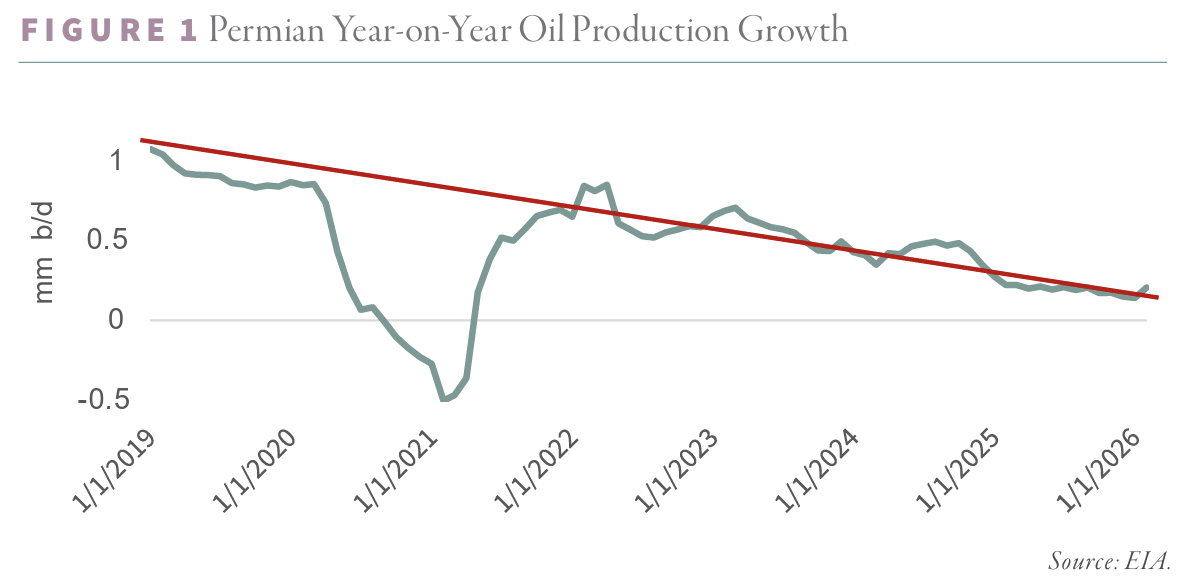
If U.S. supply growth falls short of the IEA’s expectations, the implications for the broader market become considerably more serious. With shale no longer capable of delivering rapid incremental supply, the burden of balancing the market shifts increasingly toward longercycle projects such as deepwater developments and oil sands expansions — sources of production that typically require many years rather than months to materially increase output. Russian production, meanwhile, has also begun to decline under the strain of its prolonged conflict with Ukraine, and meaningful non-OPEC supply growth outside the United States appears limited as well.
The futures market will eventually need to reprice to levels sufficiently attractive to encourage new long-cycle projects to be sanctioned. The difficulty is that such projects require time — often many years — before meaningful production can reach the market. In the meantime, the burden of balancing the system will fall on price itself. Higher prices will be needed to restrain consumption.
Investors often assume that demand destruction is inherently bearish for oil. An important distinction must be made. There is a considerable difference between demand destruction caused by a weak economy unable to absorb higher prices and demand destruction caused by a structurally undersupplied market using price to ration scarce supply. The former may indeed prove bearish. Historically, the latter has been anything but.
The historical record on this point is unambiguous. In real terms, material demand destruction has generally not emerged until oil prices approached roughly $150 per barrel or higher. WTI began this year at $58 per barrel. To clear at the levels history suggests would be required to ration demand in a structurally undersupplied market, prices would need to roughly triple from January’s starting point — and that calculation assumes no further deterioration in supply, no inventory shortfall worse than presently expected, and no upward revision to demand. Each of those assumptions, in our view, is likely to prove too generous. The eight- to ten-fold repricing seen in prior structural shifts, which would conservatively imply $150 oil from the COVID lows, is not a tail-risk scenario in this context. It is the central case the market is refusing to price. We expect that to change.
Want to learn more from Goehring & Rozencwajg? We invite you to download or revisit our entire Q1 2026 investor research letter, which is available below.

Registration with the SEC should not be construed as an endorsement or an indicator of investment skill, acumen or experience. Investments in securities are not insured, protected or guaranteed and may result in loss of income and/or principal. Historical performance is not indicative of any specific investment or future results. Investment process, strategies, philosophies, portfolio composition and allocations, security selection criteria and other parameters are current as of the date indicated and are subject to change without prior notice. This communication is distributed for informational purposes, and it is not to be construed as an offer, solicitation, recommendation, or endorsement of any particular security, products, or services. Nothing in this communication is intended to be or should be construed as individualized investment advice. All content is of a general nature and solely for educational, informational and illustrative purposes. This communication may include opinions and forward-looking statements. All statements other than statements of historical fact are opinions and/or forward-looking statements (including words such as “believe,” “estimate,” “anticipate,” “may,” “will,” “should,” and “expect”). Although we believe that the beliefs and expectations reflected in such forward-looking statements are reasonable, we can give no assurance that such beliefs and expectations will prove to be correct. Various factors could cause actual results or performance to differ materially from those discussed in such forward-looking statements. All expressions of opinion are subject to change. You are cautioned not to place undue reliance on these forward-looking statements. Any dated information is published as of its date only. Dated and forward-looking statements speak only as of the date on which they are made. We undertake no obligation to update publicly or revise any dated or forward-looking statements. Any references to outside data, opinions or content are listed for informational purposes only and have not been independently verified for accuracy by the Adviser. Third-party views, opinions or forecasts do not necessarily reflect those of the Adviser or its employees. Unless stated otherwise, any mention of specific securities or investments is for illustrative purposes only. Adviser’s clients may or may not hold the securities discussed in their portfolios. Adviser makes no representations that any of the securities discussed have been or will be profitable. Indices are not available for direct investment. Their performance does not reflect the expenses associated with the management of an actual portfolio.